Tell a students a fact and they will forget it in a day. Tell a student a story and they will remember it for life.
Stories have an increbile way of bringing curiosity and excitment into any classroom- so why not the music room? Here are our best tips and tricks to bring instruments into the elementary music room and our 3 favorite stories we use to do it!


Let’s Get Started
For a full video walk-though click the link below.
Music class without instruments just doesn’t feel complete! But without the right expectations, routines, and tools, students can quickly become overwhelmed and off-task instead of making music.
How to Introduce Instruments Effectively
1. Start with Clear Expectations
Before students even touch an instrument, set a go-to resting position:
✔️ Hands in their lap
✔️ Hands on their desk
✔️ Sitting on their hands (a great option for younger students)
Instruments are exciting and tempting, so having a consistent, simple rule helps students know when to play and when to listen. Making this a habit from day one sets them up for success!

Bring the Story to Life with Instruments!
These interactive stories include repeatable lines and student roles, making them the perfect way to connect music, movement, and storytelling.
One of our favorites? “This is the Nest that Robin Built”—a fantastic choice for grades 2-4, especially for students ready for a composing challenge!
This lesson lets students:
✔️ Assign instruments to different parts of the story
✔️ Compose simple patterns to accompany repeated lines
✔️ Experience musical storytelling in a fun and engaging way
By layering in instrumental sound effects, steady beat patterns, and simple compositions, students actively participate in the storytelling process—turning reading time into a memorable musical experience!
Rhythm & Composition Through Storytelling
In “This is the Nest that Robin Built,” students bring the story to life by adding rhythm and instrumental layers.
1️⃣ Assign Roles – Students play individually or in groups, each assigned an animal with its own rhythm.
2️⃣ Create Rhythms – Match rhythms to each character:
- Dog → Ta (quarter note)
- Fledgling → Ta-Ta or Ti-Ti? Students decide!
- Objects (string, grass, etc.) → Find a matching rhythm.
3️⃣ Build Rhythm Phrases – Tap out rhythms for key story lines. Example:
“The dog found a string long and strong.”
4️⃣ Compose & Perform – Percussion students play their rhythms, while advanced students add pitches to create melodies.
This lesson keeps students engaged, creative, and actively composing, making rhythm reading feel like play!


Bringing the Story to Life
It’s time for the final performance! Each time students hear their animal or item, they play their composition, building listening skills, anticipation, and excitement.
Why It Works:
✔️ Clear structure – Students know exactly when to play and when to listen.
✔️ Multiple chances to perform – Early roles play more often, but everyone gets a turn.
✔️ Student ownership – They created the music, making it more meaningful.
✔️ Engaging & structured – The story’s rhythm keeps students focused and excited.
By the end, students feel accomplished and proud, turning rhythm and composition into an interactive, unforgettable experience!

Take This Lesson Even Further!
Want to bring even more music and movement into your classroom? With the full lesson plan in the Soaring Scarves Academy, your students can extend their learning with even more chances to play using the song “This is the Nest.”
With this full lesson, you’ll get:
✔️ A complete written lesson plan with step-by-step guidance
✔️ One FREE Soaring Scarf Dance – a perfect way to introduce classical music through movement
✔️ Easy-to-use assessments to track student learning
✔️ A fully interactive Google Slides presentation to guide your lesson
Ready to grab it?
🎵 Sign up for a FREE month of the Soaring Scarves Academy to access:
✔️ The entire Soaring Scarves Curriculum
✔️ Tons of engaging Scarf Dances
✔️ Movement Breaks to re-energize your students
✔️ Exclusive Professional Development for music educators
✔️ And so much more!
Turn “Too Much Noise” into an Engaging, Musical Experience!
Stories are one of a teacher’s greatest tools, and they can be just as powerful in the music classroom! “Too Much Noise” by Ann McGovern is the perfect book to get your students chanting, playing steady beat, using body percussion, and working as a team—all through an engaging, interactive story.
This lesson is a game-changer for keeping students focused, involved, and excited while reinforcing key music concepts like steady beat, rhythm, dynamics, and ensemble playing.

Why This Lesson Works So Well
🎵 Call-and-Response Rhythms
Throughout the book, students chant along with repeating lines, making it easy to internalize steady beat and rhythm fluency. The pattern is simple:
✔️ The bed goes creek
✔️ The floor goes squeak
✔️ The leaves go swish-swish
✔️ The tea kettle goes hiss-hiss
Students first repeat after you, using hand motions to keep the steady beat. Once the class is confident, the story begins—with students chanting their lines at the right moments!
Watch a Full Walk Through of this Lesson Plan Here-
🎵 Instrument Matching for Interactive Storytelling
After students have mastered the rhythmic phrases, it’s time to add instruments! Each student or group is assigned a sound effect from the story and a corresponding instrument:
✔️ Cymbals for the bed creaking
✔️ Egg shakers for the floor squeaking
✔️ Scarves or wind chimes for the leaves swishing
✔️ Guiro or drum for the tea kettle hissing
Every time their sound appears in the book, students play their instrument on cue, creating a layered soundscape that enhances the story.

🎵 Building Up the “Noise”—Then Taking It Away
As the story progresses, more and more animal sounds are added. A cow, a donkey, a cat, and more all contribute to the chaos!
Each time a new animal joins, students:
✔️ Chant and play their assigned rhythm
✔️ Follow the beat while layering sounds together
✔️ Listen for their cue, building their ensemble skills
At the climax of the story, everything quiets down—each sound disappears one by one until all that remains are the original house sounds. At this moment, students experience the contrast of sound and silence, making it the perfect introduction to dynamics!
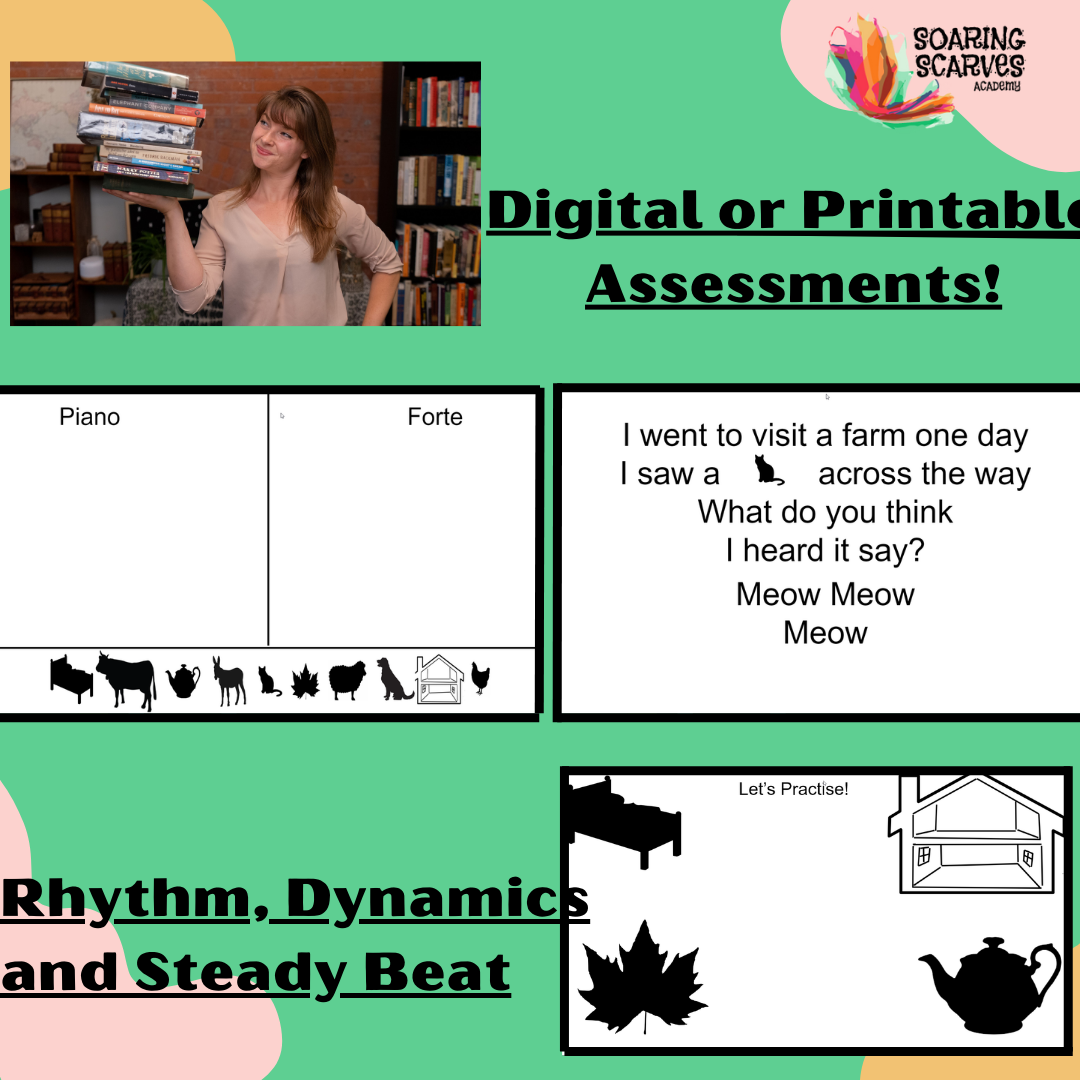
Connecting the Story to Musical Dynamics
After the final read-through, students explore how dynamics play a role in music.
🎶 “Was the bed creaking loud or soft?”
🎶 “How about the cow? Should its sound be piano (quiet) or forte (loud)?”
Using a visual sorting activity, students drag their assigned object or animal to either the piano or forte side of the board. This solidifies their understanding of how sound levels affect a musical piece.
Taking It Even Further with Instrument Play!
At this point, students are eager to play—so it’s time to fully bring the story to life with instruments!
1️⃣ Each student is given a picture card that determines their role.
2️⃣ Loud (forte) sounds get bigger, more powerful instruments like drums or tambourines.
3️⃣ Soft (piano) sounds get quieter, more delicate instruments like finger cymbals or scarves.
4️⃣ The class performs the story one last time, now fully orchestrated with dynamics and movement.
Want to increase the challenge? Have students switch roles and instruments halfway through, requiring them to adapt their playing style based on their new sound.
Bringing the Rain to Kapiti Plain: A Musical Storytelling Adventure
“Bringing the Rain to Kapiti Plain” is the perfect story to engage older elementary students in rhythm, movement, and instrumental play. With its lyrical repetition and natural flow, this lesson allows students to experience the power of musical storytelling while reinforcing rhythm, dynamics, and ensemble skills.
Why This Lesson Works
✔️ Steady Beat & Rhythm Development – The poetic structure of the book makes it easy for students to clap, tap, or play a steady beat throughout the story.
✔️ Instrumental Layering – Assign different instruments to represent parts of the story, creating a layered musical experience.
✔️ Movement & Vocal Expression – Students can act out the rainstorm, gallop like animals, or use scarves to represent the falling rain.
✔️ Call-and-Response Engagement – The predictable rhythm and repeating lines allow for an easy call-and-response format, helping students stay engaged.
Bringing the Story to Life in the Classroom
Start by having students pat the steady beat as you read. Then, add layered sounds using instruments or body percussion:
- Drums for rolling thunder
- Shakers or rain sticks for the falling rain
- Rhythmic clapping or stomping for galloping animals
As the rainstorm builds in intensity, students adjust their dynamics, experiencing how music mimics the natural world. Give each student an animal, person, or thing- cow, Kipat, Bow, Thunder, Grass, whatever you hear is being repeated many times.
By the end, students actively participate in a full-class musical performance, experiencing music, movement, and storytelling as one!

Step 1: Establish the Steady Beat
Before introducing instruments, have students pat the steady beat as you read aloud. This helps them internalize the natural rhythm of the story while building focus and anticipation. Encourage them to tap their legs, clap softly, or stomp lightly—whichever best fits the mood of the story at that moment.
Step 2: Add Layered Sound Effects
Once students are comfortable with the beat, introduce layered sound effects to enhance the storytelling. Pick Instruments that make the most sense for the repeat animal, person, or object. Think about instruments like:
🎵 Drums or low-pitched instruments for rolling thunder—deep and steady, mimicking distant rumbles.
🎵 Shakers or rain sticks for falling rain—starting soft and sparse before building to a full rainstorm.
🎵 Rhythmic clapping or cow bell for animals—keeping the energy alive as the characters move across the plain.
🎵 Chimes, maraca, or soft vocal humming for the grass, creating a flowing, atmospheric effect.
Each student or small group is assigned a specific sound role, ensuring that every student contributes to the performance in a meaningful way.
Step 3: Build Musical Intensity
As the rainstorm intensifies, students gradually adjust their volume (dynamics)—starting at a quiet piano level and growing to a full, energetic forte. This hands-on demonstration of dynamics allows students to physically feel and hear how music can mimic nature, making abstract concepts more tangible.
To maintain engagement, vary the storytelling pace—reading some parts slowly to build suspense and speeding up during the storm’s climax to create excitement.
Step 4: The Grand Performance
By the end of the lesson, students will have:
✔️ Experienced how rhythm and sound can bring a story to life.
✔️ Practiced listening and responding to musical cues.
✔️ Collaborated in a full-class musical performance, blending movement, storytelling, and instrumental play.
For an extra challenge, invite students to compose their own musical phrases to represent different moments in the story, reinforcing composition and improvisation skills!
This lesson is a fun, engaging, and highly interactive way to teach rhythm, dynamics, and ensemble playing—all while helping students connect music to storytelling in a way they won’t forget!
Bringing instruments into the classroom through storytelling makes music more engaging, structured, and meaningful. By setting clear expectations, choosing repetitive stories, and layering sounds purposefully, students learn to connect rhythm, dynamics, and ensemble playing naturally. Story-based lessons encourage active participation, creativity, and a deeper understanding of musical concepts—all while making learning fun!
Check Out Some of Our Other Articles Here!
Back-to-School Music Lessons and Free Resources for Elementary Music Teachers
Free Back-to-School Music Teacher Resources + Summer of Free Trial Back-to-School Resource Hub Back-to-School Music Lessons and Free Resources for Elementary Music Teachers The beginning of the school year can feel exciting, overwhelming, and a little chaotic all at...
No-Prep Back-to-School Music Lesson for Grades K–2: Monkey Puzzle Activities for Rhythm, Solfege & Movement
Back-to-School Music Lesson: Monkey Puzzle If you're anything like me, the beginning of the school year is all about one thing: finding out what your students remember while helping them fall back in love with music class. That's exactly why I love using Monkey...
Easy Back-to-School Music Lesson for Grades 2–4 (Dynamics, Rhythm & Movement)
Back-to-School Music Lesson: The Quiet Forest for Dynamics, Rhythm & Movement The beginning of the school year is one of my favorite times to bring storybooks into the elementary music classroom. Not because I'm trying to teach something brand new. Because I want...
30-Second Movement Breaks for Elementary Music Teachers: Easy Classroom Management Ideas
The 30-Second Movement Formula One of the biggest misconceptions about classroom movement is that it has to take a long time to make a difference. It doesn't. Some of the most effective movement moments in my classroom take less than 30 seconds. In fact, some of my...
Back-to-School Music Lesson for Kindergarten: Tap the Magic Tree, Movement, Solfege & Steady Beat
Tap the Magic Tree: A Movement-Filled Music Lesson for Kindergarten and First Grade If you are looking for a story that practically begs students to get up and move, Tap the Magic Tree by Christie Matheson might just become one of your favorite books to bring into the...
Why Movement Breaks Fail in the Elementary Music Classroom (And How to Fix Them)
Why it Fails and How to Fix! If you've ever tried adding movement to your elementary music classroom only to have the class somehow become more chaotic, you're not alone. A lot of music teachers are told to "just add movement," but nobody really talks about why...
Play the Movie and Keep the Learning Going: A No-Prep Superworm Music Lesson for Elementary Students
Superworm for Elementary Music (Movement, Solfege, Rhythm & Movie Day!) Hello, elementary music teachers. It's May. How are we doing? No really- How are we doing? Because if you're anything like I was in May, you're trying to keep students engaged, keep learning...
Elementary Music Teachers: It’s Okay to Play the Movie at the End of the Year
Keep Them Learning Along with the Movie! Play the movie. Your students may have earned it… but honestly? You have earned it! The end of the school year is a strange mix of excitement, exhaustion, field trips, missing pencils, mystery schedules, and students who...
No-Prep End of Year Music Lesson: Peter and the Wolf for Elementary Music (Sub-Plan, Movement, Listening & Assessment Included!)
Keep Them Learning Before the Movie! Alright—if you are at that point in the year where you are this close to summer and you’re thinking, “Can I just put on a movie?”… I hear you. I really do. But what if you could still give your students that Peter and the Wolf...
3 No-Prep End-of-Year Music Lessons That Actually Work (Movement, Rhythm & Engagement Built In)
No-Prep End of Year Music Lessons for K–5 Hello, elementary music teachers—it is the end of the school year, and if you’re anything like me, you’re trying to keep things engaging, meaningful, and honestly… manageable. So here’s exactly what I do. These are three of my...