
Too Much Noise: A Fun & Engaging Music Lesson for Elementary Students
Stories are a teacher’s best friend. They captivate students, teach valuable life lessons, and create experiences that stick with them for years to come. But in the elementary music classroom, stories take on an even greater role—they become a musical adventure!
“Too Much Noise” by Ann McGovern is a perfect book for bringing music concepts to life. Through this hilarious tale of Old Peter, who thinks his house is too noisy, students will:
✔️ Chant and practice a steady beat
✔️ Play instruments to represent story elements
✔️ Work as a team to create a soundscape
✔️ Engage with musical concepts in a fun, interactive way
This lesson is filled with repeating lines, clear rhythmic patterns, and built-in opportunities to explore sound through instrument play and body percussion. Let’s dive in!

Check Out Our Video Walk Through Here

Step 1: Introducing the Story & Setting the Beat
Before we even start reading, students need to get ready for their part! We begin by exploring the object sounds that Peter complains about in his home. These include:
🔹 A creaky bed – “Creeeak!”
🔹 A squeaky floor – “Squeak, squeak!”
🔹 Swishing leaves – “Swish, swish!”
🔹 A hissing tea kettle – “Hisssss!”
Each sound has a matching movement, helping students internalize the rhythm while keeping a steady beat. By practicing these sounds together, students are actively preparing to bring the story to life through music!
Step 2: Adding the Animal Sounds
As the story progresses, the wise man instructs Peter to bring animals into his home. Each animal makes a two-beat sound, creating a rhythmic pattern for students to follow:
🐄 Cow: “Moo moo”
🐓 Hen: “Cluck cluck”
🐴 Donkey: “Hee haw”
To reinforce rhythm and timing, I point randomly to different animal pictures—students must respond on beat with the correct sound. This keeps them focused, engaged, and listening carefully!
Step 3: Preparing for the Full Musical Story Performance
Now that students have mastered the animal sounds and their rhythmic patterns, it’s time to bring “Too Much Noise” to life with instruments! But before handing out instruments, we take one more step to lock in the steady beat.
Reinforcing the Beat
We read through the entire story once, with students chanting their sounds on beat while I point randomly to different pictures. This ensures that:
✔️ Every student is confident in their part
✔️ The class can keep a steady beat together
✔️ They are fully engaged and actively listening
After this first reading, I let students know that we’re about to level up—they’ll now add instruments to represent each sound!
Step 4: Adding Instruments & Dynamic Expression
Now that the beat is strong and steady, I assign instruments to different sounds in the story:
🔹 Creaky bed → Woodblocks
🔹 Squeaky floor → Egg shakers
🔹 Swishing leaves → Scarves or wind chimes
🔹 Hissing tea kettle → Guiros or rainsticks
🔹 Cow (Moo Moo) → Hand drums
🔹 Donkey (Hee Haw) → Castanets or Lumi Sticks
🔹 Hen (Cluck Cluck) → Claves or finger cymbals
Each small group or solo player is responsible for one sound effect, playing at just the right moment in the story.
Reading the Story Again—Now with Music!
We go through “Too Much Noise” a second time, but now students perform their parts using instruments at the correct moments. The class is transformed into a live soundscape, and the storytelling becomes a full musical performance!
Step 5: Exploring Dynamics & Expressive Playing
At the end of the story, Old Peter realizes that his house wasn’t actually noisy after all—it was just the perception of sound that changed. This is a perfect opportunity to introduce dynamics!
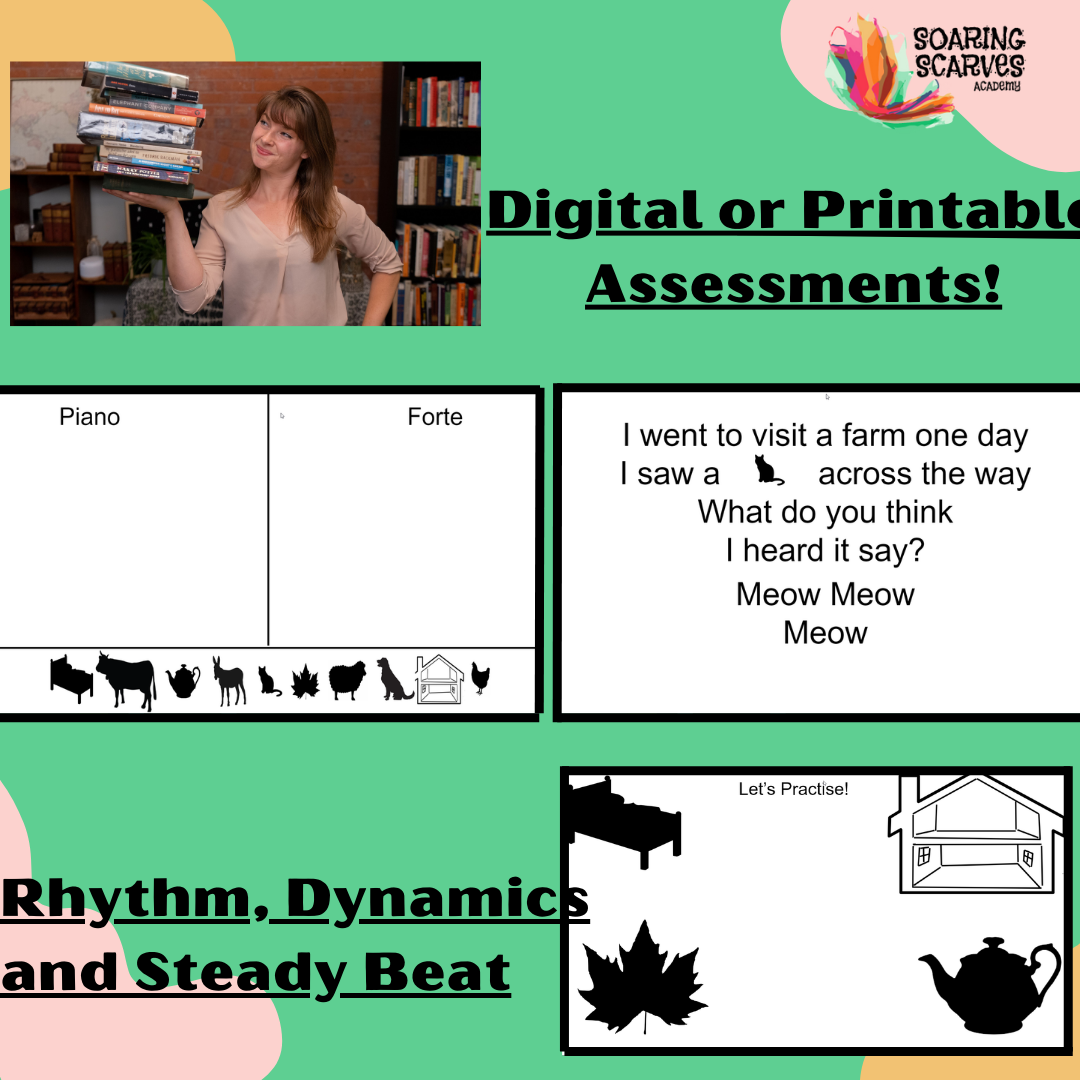
1️⃣ Sorting Sounds by Dynamics
I have students categorize each sound as either piano (soft) or forte (loud). One by one, students come up to the board and move the pictures of objects and animals into their correct category.
2️⃣ Performing with Dynamics
We read the story one final time, but this time, students must play their instruments with the correct dynamic level.
- The creaky bed and swishing leaves stay soft (piano).
- The cow and donkey are played loud (forte).
- The hissing tea kettle starts soft but gradually crescendos to a full whistle!
By layering in expressive elements, students internalize musical dynamics in a meaningful way.
Bringing Stories to Life Through Music
“Too Much Noise” is the perfect example of how storytelling and music can come together to create an engaging, interactive, and educational experience for elementary students. By combining chanting, steady beat practice, instrument play, and dynamic exploration, students don’t just hear a story—they become part of it!
This lesson reinforces essential music skills while keeping students actively involved through movement, listening, and performance. Most importantly, it reminds us that music should be felt, experienced, and enjoyed—not just learned!
Looking for more lessons like this? Join The Soaring Scarves Academy and get access to a full music curriculum, movement-based activities, and professional development—all designed to make your music classroom more engaging and effective.
Let’s make music come alive for our students—one story at a time!

Check Out Some of Our Other Articles Here~
Back-to-School Music Lessons and Free Resources for Elementary Music Teachers
Free Back-to-School Music Teacher Resources + Summer of Free Trial Back-to-School Resource Hub Back-to-School Music Lessons and Free Resources for Elementary Music Teachers The beginning of the school year can feel exciting, overwhelming, and a little chaotic all at...
No-Prep Back-to-School Music Lesson for Grades K–2: Monkey Puzzle Activities for Rhythm, Solfege & Movement
Back-to-School Music Lesson: Monkey Puzzle If you're anything like me, the beginning of the school year is all about one thing: finding out what your students remember while helping them fall back in love with music class. That's exactly why I love using Monkey...
Easy Back-to-School Music Lesson for Grades 2–4 (Dynamics, Rhythm & Movement)
Back-to-School Music Lesson: The Quiet Forest for Dynamics, Rhythm & Movement The beginning of the school year is one of my favorite times to bring storybooks into the elementary music classroom. Not because I'm trying to teach something brand new. Because I want...
30-Second Movement Breaks for Elementary Music Teachers: Easy Classroom Management Ideas
The 30-Second Movement Formula One of the biggest misconceptions about classroom movement is that it has to take a long time to make a difference. It doesn't. Some of the most effective movement moments in my classroom take less than 30 seconds. In fact, some of my...
Back-to-School Music Lesson for Kindergarten: Tap the Magic Tree, Movement, Solfege & Steady Beat
Tap the Magic Tree: A Movement-Filled Music Lesson for Kindergarten and First Grade If you are looking for a story that practically begs students to get up and move, Tap the Magic Tree by Christie Matheson might just become one of your favorite books to bring into the...
Why Movement Breaks Fail in the Elementary Music Classroom (And How to Fix Them)
Why it Fails and How to Fix! If you've ever tried adding movement to your elementary music classroom only to have the class somehow become more chaotic, you're not alone. A lot of music teachers are told to "just add movement," but nobody really talks about why...
Play the Movie and Keep the Learning Going: A No-Prep Superworm Music Lesson for Elementary Students
Superworm for Elementary Music (Movement, Solfege, Rhythm & Movie Day!) Hello, elementary music teachers. It's May. How are we doing? No really- How are we doing? Because if you're anything like I was in May, you're trying to keep students engaged, keep learning...
Elementary Music Teachers: It’s Okay to Play the Movie at the End of the Year
Keep Them Learning Along with the Movie! Play the movie. Your students may have earned it… but honestly? You have earned it! The end of the school year is a strange mix of excitement, exhaustion, field trips, missing pencils, mystery schedules, and students who...
No-Prep End of Year Music Lesson: Peter and the Wolf for Elementary Music (Sub-Plan, Movement, Listening & Assessment Included!)
Keep Them Learning Before the Movie! Alright—if you are at that point in the year where you are this close to summer and you’re thinking, “Can I just put on a movie?”… I hear you. I really do. But what if you could still give your students that Peter and the Wolf...
3 No-Prep End-of-Year Music Lessons That Actually Work (Movement, Rhythm & Engagement Built In)
No-Prep End of Year Music Lessons for K–5 Hello, elementary music teachers—it is the end of the school year, and if you’re anything like me, you’re trying to keep things engaging, meaningful, and honestly… manageable. So here’s exactly what I do. These are three of my...